Operational News
Updates on algorithm or data modifications, as well as notifications regarding any recent news of temporary data gaps or degraded data quality.
Blog Posts
-
L4 CryoSat-2/Sentinel-3/SMOS (CS3SMOS) near real-time sea ice thickness processing ends for the Arctic 2025/26 winter season
created by
Apr 21, 2026
-
The L3 product has been switched from the Arctic to the Antarctic.
created by
Apr 17, 2026
-
L4 CryoSat-2/Sentinel-3/SMOS near real-time sea ice thickness processing has started for the Arctic 2025/26 winter season
created by
Oct 23, 2025
-
L3 SMOS sea ice thickness processing started for 2025/26 winter season.
created by
Oct 17, 2025
-
SMOS L3 v3.3 production is back to normal
created by
Jun 10, 2025
-
Update on SMOS L3 Sea Ice Thickness Data Production v3.3
created by
Jun 06, 2025
-
Operational L3 SMOS sea ice thickness production ended for the 2024/25 winter season for the Arctic and switched to the Antarctic since 15 April.
created by
Apr 17, 2025
-
L4 CryoSat-2/SMOS v206 near real time completed for winter season 2024/25
created by
Apr 17, 2025
-
L3 SMOS v3.3 and L4 CryoSat-2/SMOS v206 near real time production is resumed.
created by
Mar 03, 2025
-
L4 CryoSat-2/SMOS v206 near real-time production interrupted
created by
Feb 24, 2025
Abstract
The SMOS & CryoSat-2 Sea Ice Data Product Processing and Dissemination Service (CS2SMOS-PDS) ensures the automated and continuous operational generation of the SMOS and the merged CryoSat-2/Sentinel-3/SMOS Sea Ice Thickness products.
Data access
Daily SMOS and weekly merged CryoSat-2/SMOS sea ice thickness data can be downloaded via FTP through a Web browser, a FTP client (e.g. FileZilla) or command line. The access is anomymous.
Alternatively, data can be downloaded from the ESA SMOS Dissemination server by ftps and https:
Info
How to cite the data
For the merged CryoSat-2/SMOS sea ice thickness data, please
cite:
Ricker, R., Hendricks, S., Kaleschke, L., Tian-Kunze, X., King, J., and Haas, C.: A weekly Arctic sea-ice thickness data record from merged CryoSat-2 and SMOS satellite data, The Cryosphere, 11, 1607-1623, https://doi.org/10.5194/tc-11-1607-2017, 2017.
include the following phrase into the acknowledgment:
"The production of the merged CryoSat-SMOS sea ice thickness data was funded by the ESA project SMOS & CryoSat-2 Sea Ice Data Product Processing and Dissemination Service, and data from DATE to DATE were obtained from AWI."
For the SMOS Sea Ice Thickness data, please
cite:
Tian-Kunze, X. , Kaleschke, L., Maaß, N., Mäkynen, M., Serra, N., Drusch, M., and Krumpen, T. (2014) SMOS-derived thin sea ice thickness: algorithm baseline, product specifications and initial verification, The Cryosphere , 8, 997-1018, doi:10.5194/tc-8-997-2014
include the following phrase into the acknowledgment:
"The production of the SMOS sea ice thickness data was funded by the ESA project SMOS & CryoSat-2 Sea Ice Data Product Processing and Dissemination Service, and data from DATE to DATE were obtained from AWI."


Operational processing of the Level-4 (L4) CryoSat-2/Sentinel-3/SMOS (CS3SMOS) sea ice thickness product has ended for the Arctic 2025/26 winter season.
The final seea ice thickness field from April 9 to April 15, 2026 is shown below.
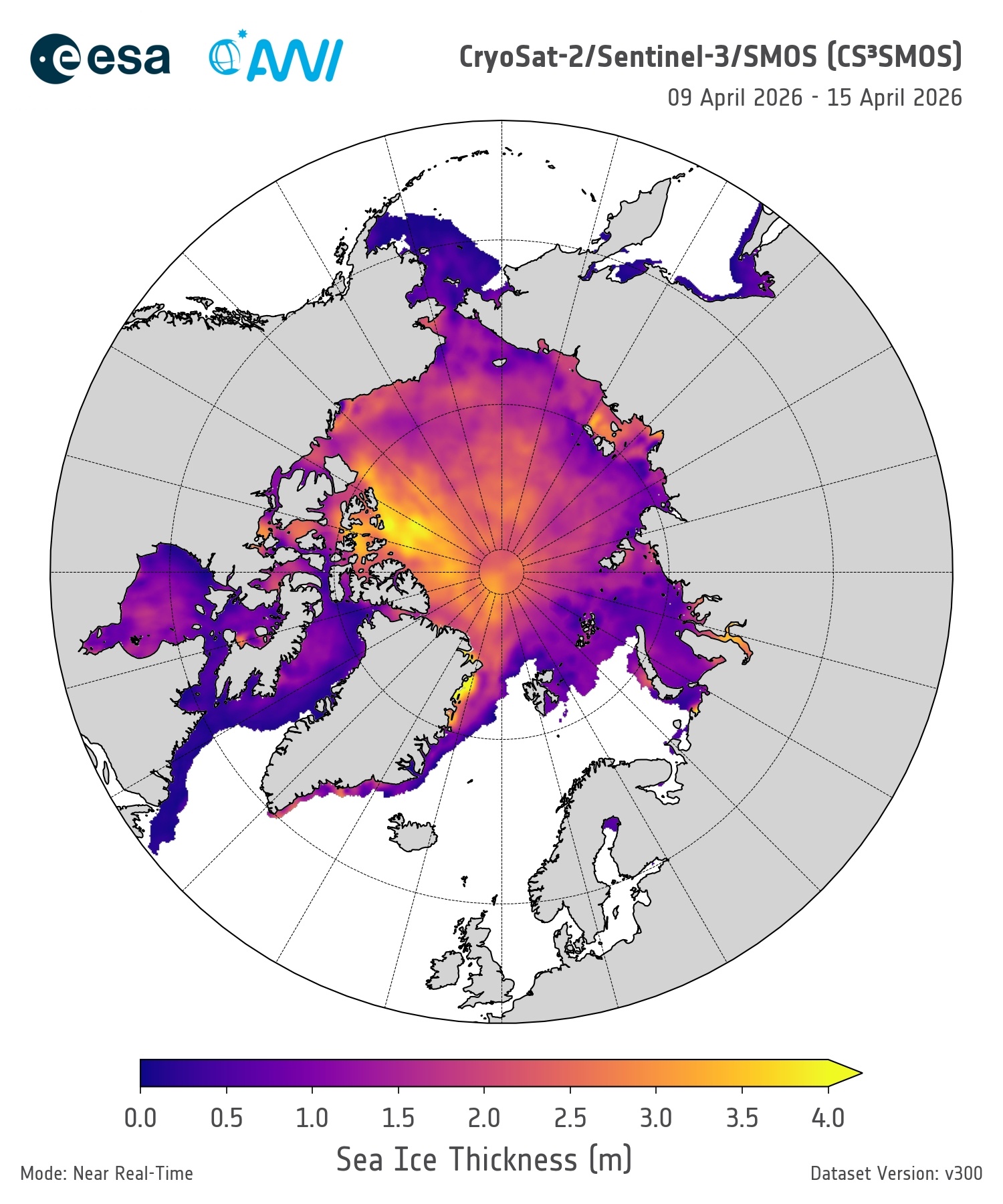
Operational processing of the southern hemisphere will start shortly.
Operational processing and dissemination of L3 sea ice thickness products in the Arctic for the 2025/2026 winter season ended on 15 April, 2026. Operational L3 SMOS data for the southern hemisphere is now available from 15 April, 2026 on for the austral winter season.
Operational processing of the Level-4 (L4) CryoSat-2/Sentinel-3/SMOS (CS3SMOS) sea ice thickness product has been started for the Arctic 2025/26 winter season. The product version has seen a major upgrade from v206 (CryoSat-2 & SMOS, CS2SMOS) to v300 (CS3SMOS).
Notable Changes
- Sentinel-3 radar altimeter data has been added to the sea ice thickness input data sources
- Spatial resolution improved from 25 km of 12.5 km
- Antarctic winter sea ice thickness between April and October.
- New file format and content
For the full list of changes, see Documentation & Changelog.
Product Degradation Warning

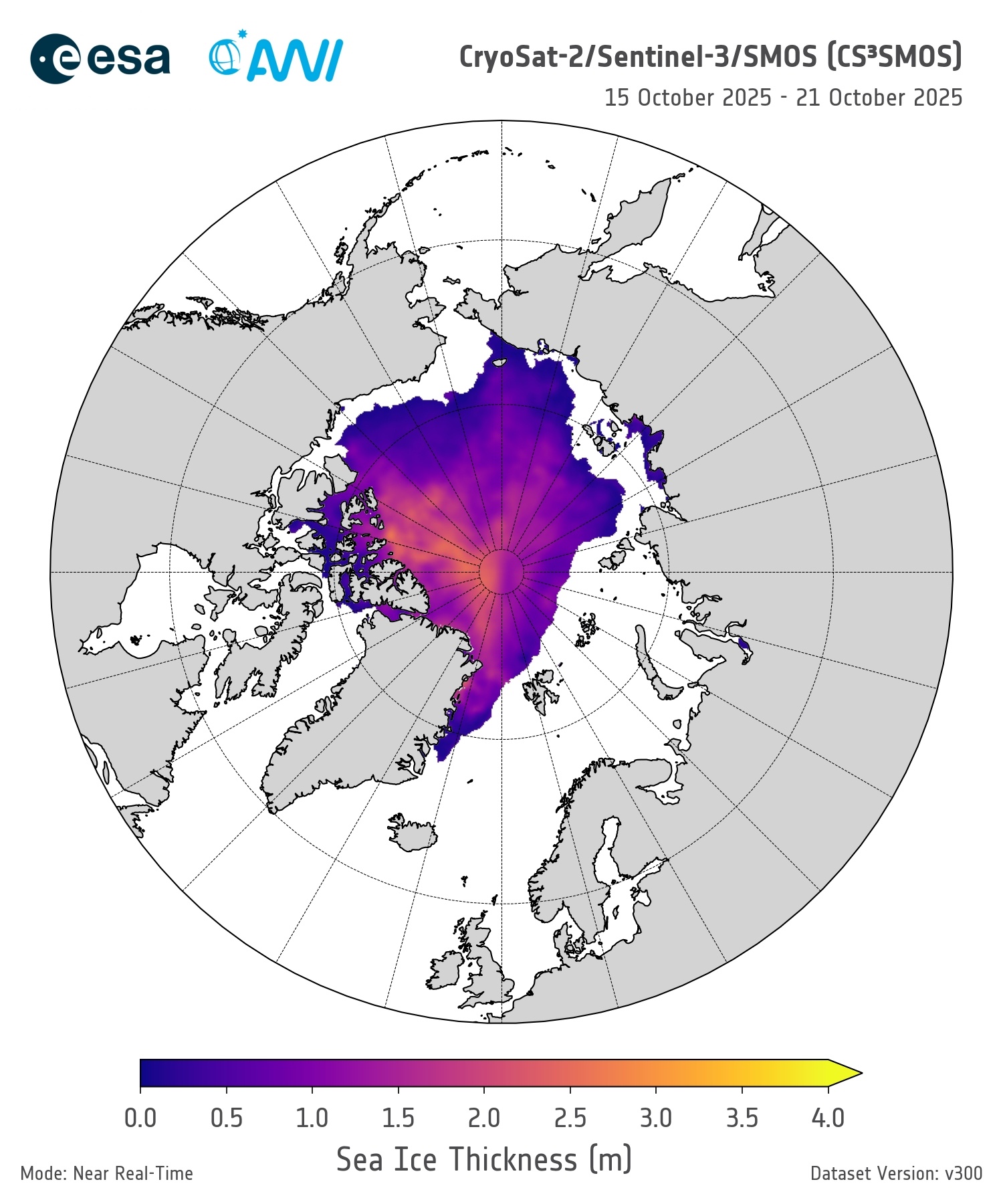
SMOS input data continues to be affected by persistent and frequent radio-frequency interference (RFI) in the Barents, Kara, and Laptev Seas, resulting in missing thin ice thickness measurements (see Figure on the right). Consequently, sea ice thickness estimates for this region in the product will rely exclusively on radar altimeter data, which may lead to higher reported values than would have been obtained using SMOS data.
Operational processing and dissemination of the Level 3 (L3) SMOS Sea Ice Thickness (SIT) product have resumed for the winter season 2025/26 as of 15 October 2025.
The product version has been updated from v3.3 to v3.6. For details on the updates and processing changes, please refer to the ReadMe Technical Note (ReadMe-TN) and the Product Description Document (PDD).
The production of SMOS L3 sea ice thickness data has been recovered since 6 June after a short disruption due to missing Near Real Time JRA-3Q data. The missing L3 data from 3-5 June has been reprocessed.
Due to scheduled maintenance on the NSF NCAR HPC systems production of the SMOS L3 sea ice thickness data version 3.3 has been suspended since 2 June 2025. We use the JRA-3Q as auxiliary data for the SMOS L3 sea ice thickness product version v3.3 and an ERA5-derived climatology for the product version v3.6. Therefore, version v3.6 is not affected and will continue to be produced normally. The higher-level merged L4 sea ice thickness product version v300 is not impacted and remains operational. SMOS L3 Sea Ice Thickness Data Production v3.3 will be reprocessed when the auxiliary data are available.
Operational processing and dissemination of L3 sea ice thickness products in the Arctic for the 2024/25 winter season ended on 15 April, 2025. Operational L3 SMOS data for the southern hemisphere is now available from 15 April, 2025 on for the austral winter season.
The near real time L4 CryoSat-2 SMOS v206 data product has reached the end of the current winter season in the northern hemisphere. The production will be continued in October 2025 with a new version 300, which includes data also from Sentinel-3A and Sentinel-3B and is generated at an improved spatial resolution (12.5km instead of 25km).

The problem with JMA's JRA-3Q data server downtime is now solved and the production of L3 SMOS and L4 CryoSat-2/SMOS sea ice thickness data has been resumed since 3 March, 2025. Part of the missing L3 and L4 data was reprocessed. During following periods data are still missing:
• 4-16 February L3 SMOS sea ice thickness data are missing.
• from the week 20250204_20250210 to week 20250217_20250223 L4 CryoSat-2/SMOS sea ice thickness data are missing.
The near real-time CryoSat-2/SMOS data product is currently not updated due to a continued unavailability of JRA-3Q reanalysis data and corresponding interruption of SMOS sea ice thickness products (SMOS L3 v3.3 data production stopped 2025-02-03). The reprocessed CryoSat-2/SMOS data is currently not affected.
Missing product files will be reprocessed upon availability of the missing input data.
Due to a downtime of JMA's JRA-3Q data server, production of the SMOS L3 sea ice thickness data v3.3 has been suspended since 3 February 2025. We use the JRA-3Q as auxiliary data for the SMOS L3 sea ice thickness product version v3.3 and an ERA5-derived climatology for the product version v3.4. Therefore, version v3.4 is not affected and will be produced normally. The higher-level merged L4 sea ice thickness product v206 is accordingly affected, while the version v300 is not affected.
Operational processing and dissemination of near-real time L4 SMOS sea ice thickness product (v206) has been resumed for the winter season of 2024/25 since 15 October 2024.
A new version v300 will soon be offered in parallel to v206 for a transitional period. Watch this space for updates.
Changes of Note for version 300
- Addition of radar altimeter data from Sentinel-3A (since 2016-10) and Sentinel-3B (since 2018-10)
- Update to new SMOS sea ice thickness version 3.4
- Improved spatial resolution (12.5 km instead of 25 km)
- The Level-4 product will be generated for the southern hemisphere between mid-April and mid-October
Operational processing and dissemination of L3 SMOS sea ice thickness product (v3.3) has been resumed for the winter season of 2024/25 since 15 October 2024.
A new version v3.4 will soon be offered in parallel for a transitional period. Watch this space.
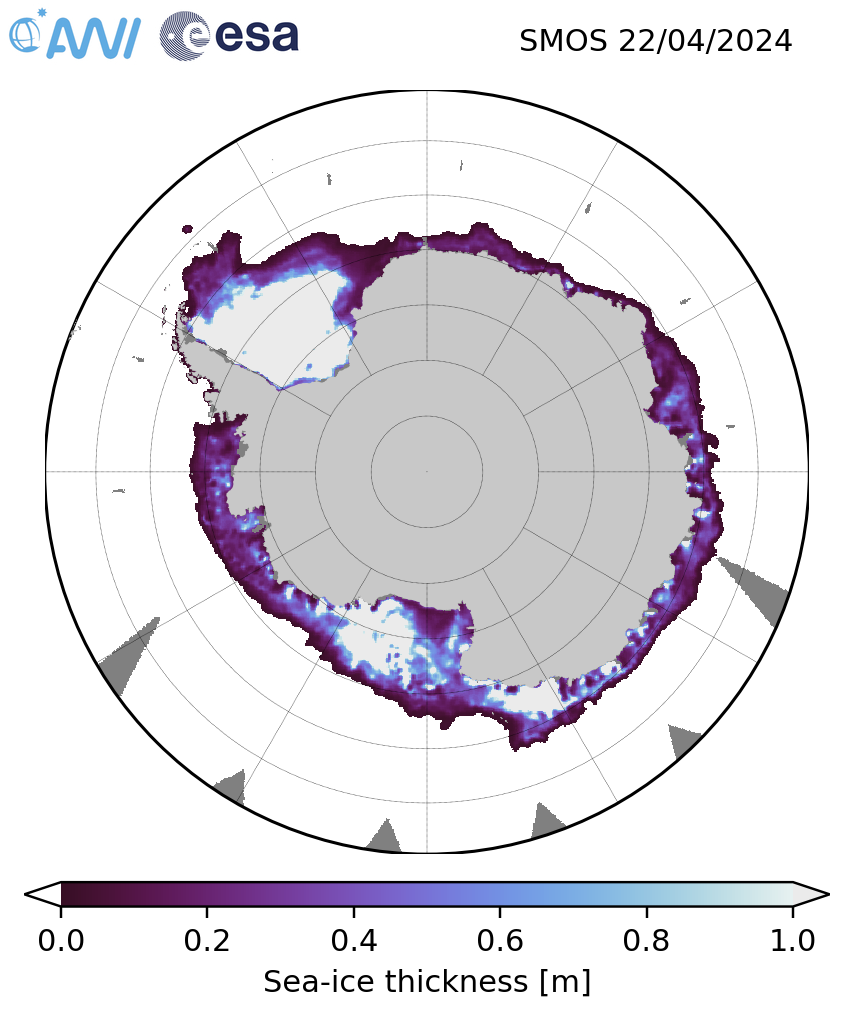
Operational processing and dissemination of L3 and L4 sea ice thickness products in the Arctic for the 2023/24 winter season ended on 15 April, 2024. Reprocessing of L4 CS2SMOS product (r product) will continue until end of May. Operational L3 SMOS data for the southern hemisphere is now available from 15 April, 2024 on for the austral winter season.
The v3.3 L3 SMOS data from 2010 to 2023 for the southern hemisphere is available under ftps://ftp.awi.de and ESA server:
The production of L4 CryoSat-2/SMOS sea ice thickness data has been resumed on after enough SMOS data became available for the optimal interpolation data requirements.
The data gap currently includes data from 16 days:
| Last file before the gap | W_XX-ESA,SMOS_CS2,NH_25KM_EASE2_20240221_20240227_o_v206_01_l4sit.nc |
|---|---|
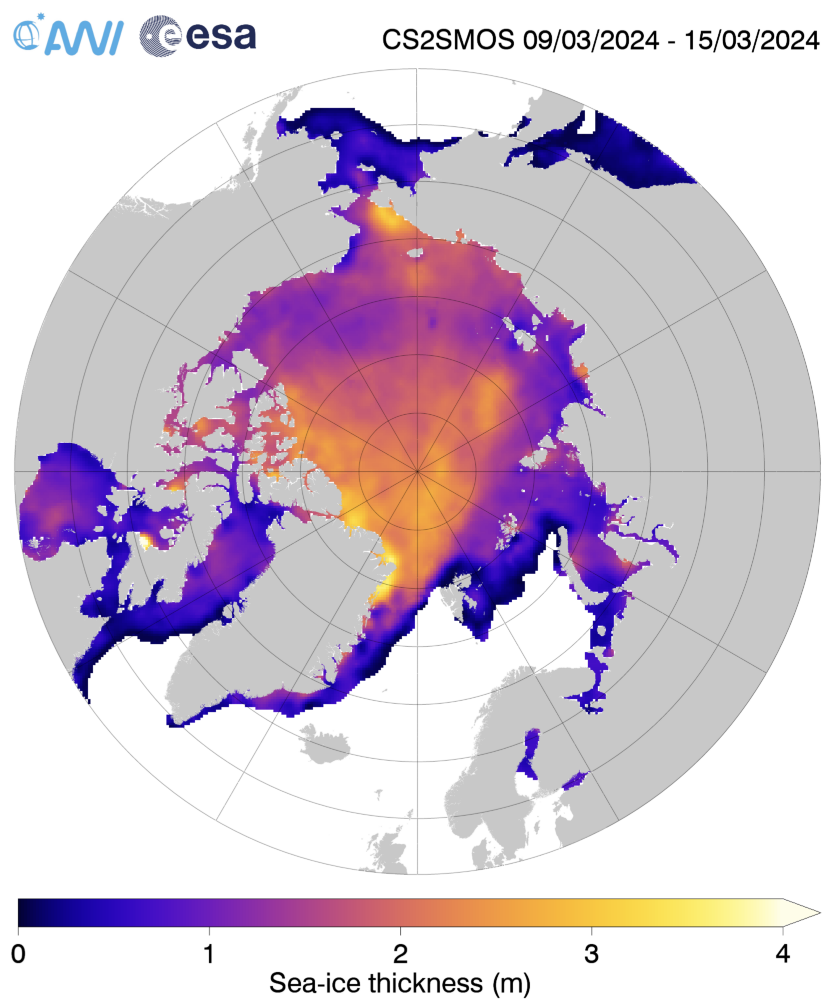
| First file after the gap | W_XX-ESA,SMOS_CS2,NH_25KM_EASE2_20240309_20240315_o_v206_01_l4sit.nc |